

Nearly 90% of Europe’s Battery Manufacturing at Danger from Franco-German Automotive Deal


Europe has large potential for battery vegetation however calls to weaken or delay the Industrial Accelerator Act and carmaker calls for to weaken the EU’s CO2 requirements, threat handing Europe’s battery worth chain to international rivals
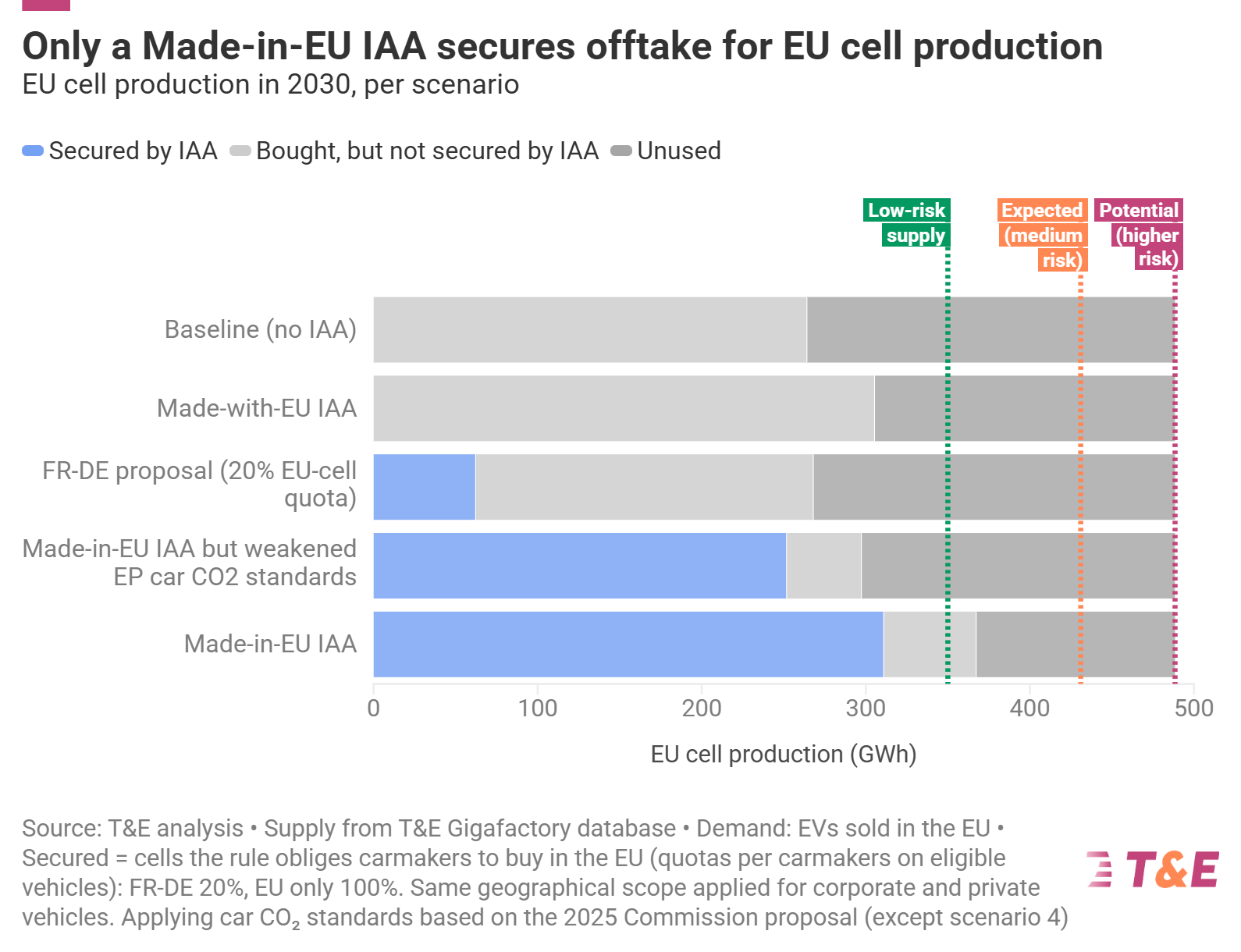
The Franco-German automotive deal will safe simply 13% of Europe’s deliberate battery cell manufacturing in 2030, new T&E evaluation reveals. Weak Made-in-Europe guidelines, mixed with weaker emission discount targets, dangers handing over the marketplace for battery manufacturing to Europe’s rivals, says T&E.
The IAA introduces native content material necessities to make sure scarce public subsidies and company tax incentives anchor homegrown EU manufacturing. 100 GWh of cells and 250 GWh of cathodes may leak overseas due to weak Made-in-Europe guidelines, the evaluation reveals — equal to 1.5 million battery packs.
On the identical time, Europe’s battery business faces a double blow from the EU Parliament’s proposals to weaken emission discount guidelines which can lower cell demand by 247 GWh or roughly 3.7 million EU made EVs between 2027 and 2032 — nearly 3 times the annual capability of Europe’s largest battery plant, LG Vitality Resolution in Poland.
Franziska Grüning, Uncooked Supplies Officer at T&E, stated: “The Franco-German deal is a catastrophe for Europe’s battery business. Securing a full European battery worth chain, from mining to manufacturing, and the excessive worth jobs it can present, ought to be a high precedence for Europe’s leaders. As a substitute, they’re debating how far to weaken guidelines that will safe domestically produced batteries. Weak native content material incentives for batteries within the IAA will ship a horrible political sign for the way forward for Europe’s battery business. Homegrown corporations struggling to cross the valley of loss of life ought to profit from an IAA demand enhance.”
With many cell factories solely simply starting to ramp up, most EU manufacturing anticipated by 2030 comes from vegetation that haven’t but entered manufacturing. The way forward for factories equivalent to Lyten (previously Northvolt) in Sweden, PowerCo Salzgitter in Germany, or Verkor Dunkirk in France, may very well be jeopardised by this deal.
Key findings:
- The Franco-German deal locks in lower than the market already does: it requires EU-made cells in solely 10% of eligible autos in 2028-2029, 20% in 2030-2031 and 70% from 2032. But over 50% of cells in EVs bought within the EU are already made in Europe. In 2030, the Franco-German deal would safe cell manufacturing equal to round 0.9 million EVs, in opposition to 4.6 million below a Made-in-EU IAA.
- Together with free commerce (FTA) companions shifts demand overseas: a large FTA scope lets low-cost nations take up demand earlier than Europe. Round 100 GWh of cell demand, or roughly 1.5 million electrical vehicles, and 250 GWh of Cathode Lively Materials (CAM) demand are prone to leakage in 2030.
- The IAA can construct the EU’s midstream: Cells are necessary however so are its elements. CAM producers want massive, secure contracts with cell makers and carmakers earlier than they will ramp up. Below a strict Made-in-EU scope, CAM necessities are reachable by 2030, with solely restricted provide from trusted companions. From 2032, EU manufacturing alone may cowl demand: the IAA would create 323 GWh of further demand, bringing complete EU-made CAM to 407 GWh and securing 94% of anticipated EU provide.
The EU’s battery business should not go the identical approach as its photo voltaic panels business, says T&E, which calls on the EU to reject the Franco-German deal proposal on batteries, and persist with the timelines and battery necessities of the EU Fee’s proposal. As well as, a strict Made-in-EU scope, or at most a slim listing of trusted companions of the EU27 plus the European Financial Space (EEA) and the UK, have to be launched, and there ought to be no additional weakening of the automotive CO2 requirements.
Obtain the briefing.
Article from T&E.
