

If Tesla’s Robotaxi Miles Hold Compounding at 20% a Week, the Math Will get Attention-grabbing Quick


Help CleanTechnica’s work by a Substack subscription, on Patreon, or on Stripe. Assist us produce all the high-quality, unique content material we publish week after week regardless of the challenges of content-scraping AI, delinquent media, inflation, and different hurdles.

Tesla simply handed Waymo in Austin in weekly driverless miles. If its latest 20% weekly progress holds, it passes Waymo nationally in roughly 11 weeks and is doing the amount of Uber + Lyft throughout three Texas metros by mid-February.
The accumulating unsupervised miles are already massive sufficient to begin answering the security query versus people and versus Waymo. That has implications for whether or not LiDAR is definitely required.
I famous in my Q3 earnings abstract that Tesla’s unsupervised robotaxi miles jumped from 250,000 final quarter to about 1.7 million, after which the identical day the corporate stated they have been already at 3.3 million. That means roughly 20% weekly progress on the latest run. I need to take that quantity significantly for a restricted window and see the place it goes relative to Waymo and to the precise ride-hail market within the Texas cities the place Tesla is already working. Then I’ll draw some conclusions.
It appears to be like like Tesla has already surpassed Waymo in Austin. Subsequent, let’s take a look at what it might take for them to go Waymo nationally and for them to begin to eat into Uber and Lyft marketshare.
The Math By means of the Crossovers
Tesla Unsupervised Weekly Miles Projection (20% compound weekly progress from present nationwide unsupervised miles/week):
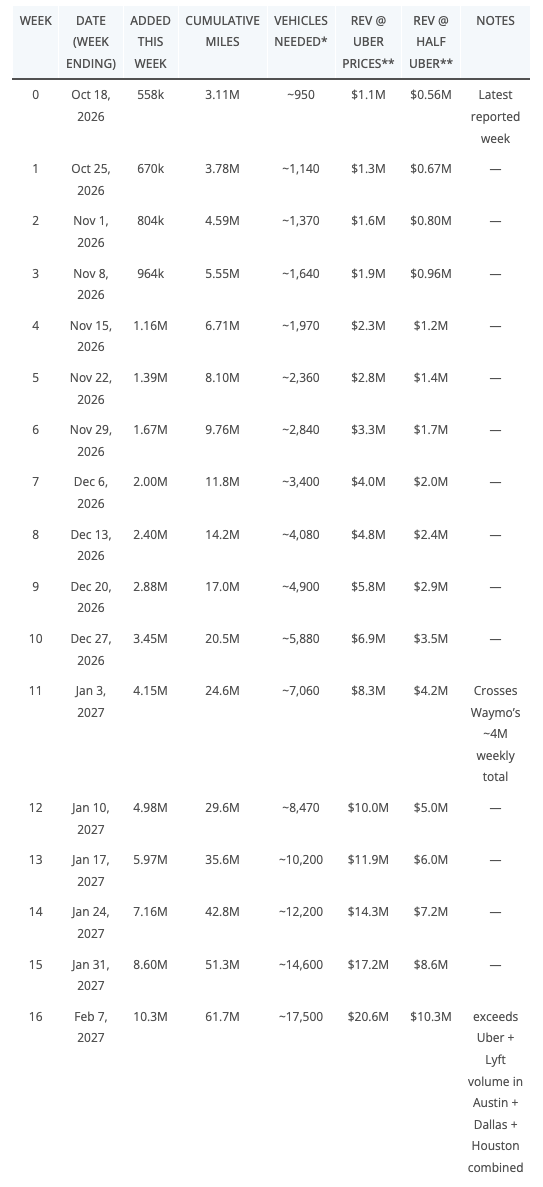
From 558K/week, the speed crosses Waymo’s latest ~4 million weekly nationwide complete in round week 11. By week 16, the weekly price could be roughly 10 million miles. That’s the level the place Tesla’s weekly quantity would exceed half the present Uber + Lyft quantity in Austin, Dallas, and Houston mixed.
How Quick Has Waymo Truly Been Rising?
Waymo’s latest numbers make the crossover extra hanging. By means of the tip of June 2026, the corporate had logged 271.3 million cumulative rider-only miles. In Q2 2026, it added solely about 50.7 million miles, versus 49.9 million in Q1—sequential progress of roughly 1.6%. Earlier quarters in 2025 had seen quarterly progress of 15% or higher. Metropolis-level knowledge exhibits the identical cooling: Phoenix has posted two straight quarterly declines, Austin’s quarter-over-quarter progress fell from over 100% early in 2025 to about 4% in Q2 2026, Los Angeles was close to 9%, and San Francisco was close to 13%. Atlanta grew sooner off a small base, however the general image is a big put in base whose share progress has slowed sharply. Even when Waymo regains its quarterly progress of 15%, that’s dramatically decrease than the 970% quarterly progress implied in my desk above.
Austin, Dallas, and Houston: The Reasonable Close to-Time period Market
The Austin metro space has roughly 2.4–2.6 million folks and about 45 million vehicle-miles traveled per day (roughly 315 million per week). Waymo’s latest weekly price there may be about 400,000 miles; Tesla’s most up-to-date tracked week in Austin was about 438,000 miles. Each are nonetheless tiny fractions of complete driving. Dallas–Fort Price (~5.7 million folks, ~157 million day by day VMT) and Houston (~5.9 million folks, ~144 million day by day VMT) are considerably bigger. Tesla’s present Dallas zone is already greater than its early Austin footprint (roughly 81 sq. miles) and has logged over 600,000 cumulative unsupervised miles. Houston stays smaller: about 25 sq. miles and roughly 226,000 cumulative miles. Waymo is current in each cities with public service. Estimated weekly Uber + Lyft miles (mixed, paid passenger miles solely):
-
- Austin: 1.5–2.5 million
-
- Dallas–Fort Price: 4–6 million
-
- Three-city complete: roughly 10–14 million
Pricing Adjustments the Addressable Market
If Tesla costs at roughly half of Uber, the related market is not restricted to ride-hail substitution. Private driving within the three metros is tons of of hundreds of thousands of miles per week. Even a 1–2% shift of journeys which can be at the moment pushed privately turns into a number of million extra weekly miles as soon as the per-mile value drops nicely beneath the totally loaded value of proudly owning and working a private automotive for a lot of journeys. Some off-peak or transfer-heavy transit journeys (CapMetro, DART, Metro) grow to be aggressive as nicely.
The sensible near-to-medium-term alternative in simply these three cities is due to this fact bigger than the 5–7 million weekly ride-hail slice—doubtlessly 10–20+ million as soon as personal-trip substitution seems. The 16-week 20% compounding path already reaches ~10 million weekly miles. That clears half the present Uber + Lyft complete within the three cities and leaves room for the beginning of personal-trip substitution, supplied the Dallas and Houston geofences broaden sufficient and the fleet scales to soak up the demand. Sustaining 20% weekly for 16 straight weeks whereas additionally enlarging the service areas is the operational query, not the demand query. Worth turns into the demand lever as soon as the autos and the geofences are massive sufficient.
What May Go Flawed
The arithmetic is clear. The trail from right here just isn’t.
First, the 20% weekly price is a launch price noticed whereas absolutely the numbers are nonetheless small and concentrated in a single metropolis. Sustaining it for 16 weeks means the weekly addition itself has to continue to grow. That requires both fast automobile deployment or a pointy rise in utilization per automobile. Each get tougher because the fleet expands: charging infrastructure has to maintain tempo, upkeep capability has to scale, and native regulators need to approve bigger working zones. A single high-profile incident that triggers a pause in any of the three cities would flatten the curve instantly.
Second, geofence growth just isn’t computerized. Dallas and Houston at the moment function in far smaller zones than Austin. Transferring them to Austin-scale protection entails mapping, native permits, and public acceptance. Any delay pushes the amount absorption downside into 2027.
Third, utilization can fall even when the fleet grows. If autos spend extra time empty, charging, or ready for demand that has not but shifted from private automobiles, the miles per automobile drop and the required fleet dimension rises.
Fourth, pricing at half of Uber’s worth assumes Tesla can nonetheless cowl its prices at that degree. If insurance coverage, distant help, or cleansing prices run increased than anticipated, the worth lower both shrinks or disappears, and the personal-trip substitution story weakens.
None of those are deadly. They’re the peculiar constraints that flip an early exponential into an S-curve. The 16-week path clears the mathematics for a fabric place relative to present ride-hail in three Texas cities. Whether or not the autos, the zones, and the operations arrive on that schedule is the open query.
My Learn
Tesla just isn’t primarily making an attempt to out-mile Waymo on a share foundation. It’s making an attempt to indicate that the unit economics of an unsupervised Cybercab (or Mannequin Y) can work at scale, with income anticipated to grow to be noticeable in 2027. The latest 20% weekly progress is the clearest sign but that the software program has cleared an inner high quality bar within the cities the place it’s operating—and the accumulating unsupervised miles already present a significant foundation to match security outcomes towards each human drivers and Waymo. If Tesla’s price of incidents continues to carry because the fleet scales, it undercuts the long-standing declare that LiDAR is required to function extra safely than people.
Superior outcomes relative to Waymo would additional recommend that extra succesful software program issues greater than merely including sensors to much less subtle programs. Whether or not the identical progress price will be sustained lengthy sufficient for the weekly complete to go Waymo’s, and whether or not Dallas and Houston will be introduced as much as Austin-like protection within the subsequent 4 months, are the subsequent two questions. Historical past suggests not less than one constraint seems earlier than the curve stays completely exponential, however the arithmetic not requires an absurd variety of cities or an unattainable fleet to grow to be materials relative to present ride-hail. Any progress they make in Florida (my dwelling state) in Miami, Orlando, Tampa, and Jacksonville is a bonus for the brief time period, however they should proceed their progress going ahead.
If you wish to reap the benefits of my Tesla referral hyperlink to rise up three months Full Self Driving, right here’s the hyperlink: https://ts.la/paul92237 — but when one other proprietor helped you extra, please use their hyperlink as a substitute of mine. Disclosure: I’m a shareholder in Tesla and XPeng. I supply no funding recommendation of any type.
Join CleanTechnica’s Weekly Substack for Zach and Scott’s in-depth analyses and excessive degree summaries, join our day by day e-newsletter, and comply with us on Google Information!
Have a tip for CleanTechnica? Need to promote? Need to recommend a visitor for our CleanTech Speak podcast? Contact us right here.
Join our day by day e-newsletter for 10–15 new cleantech tales a day. Or join our weekly one on prime tales of the week if day by day is simply too frequent.


CleanTechnica makes use of affiliate hyperlinks. See our coverage right here.
CleanTechnica’s Remark Coverage
