

Fast Transition to Electrical Firm Automobiles May Generate 344,000 EU Jobs by 2030 — Examine


Assist CleanTechnica’s work via a Substack subscription, on Patreon, or on Stripe. Assist us produce the entire high-quality, unique content material we publish week after week regardless of the challenges of content-scraping AI, delinquent media, inflation, and different hurdles.
Setting targets on corporations to go electrical and limiting monetary assist just for firm automobiles which might be electrical and Made-in-EU would see financial positive factors of €20 bn and enhance investments by €18 bn
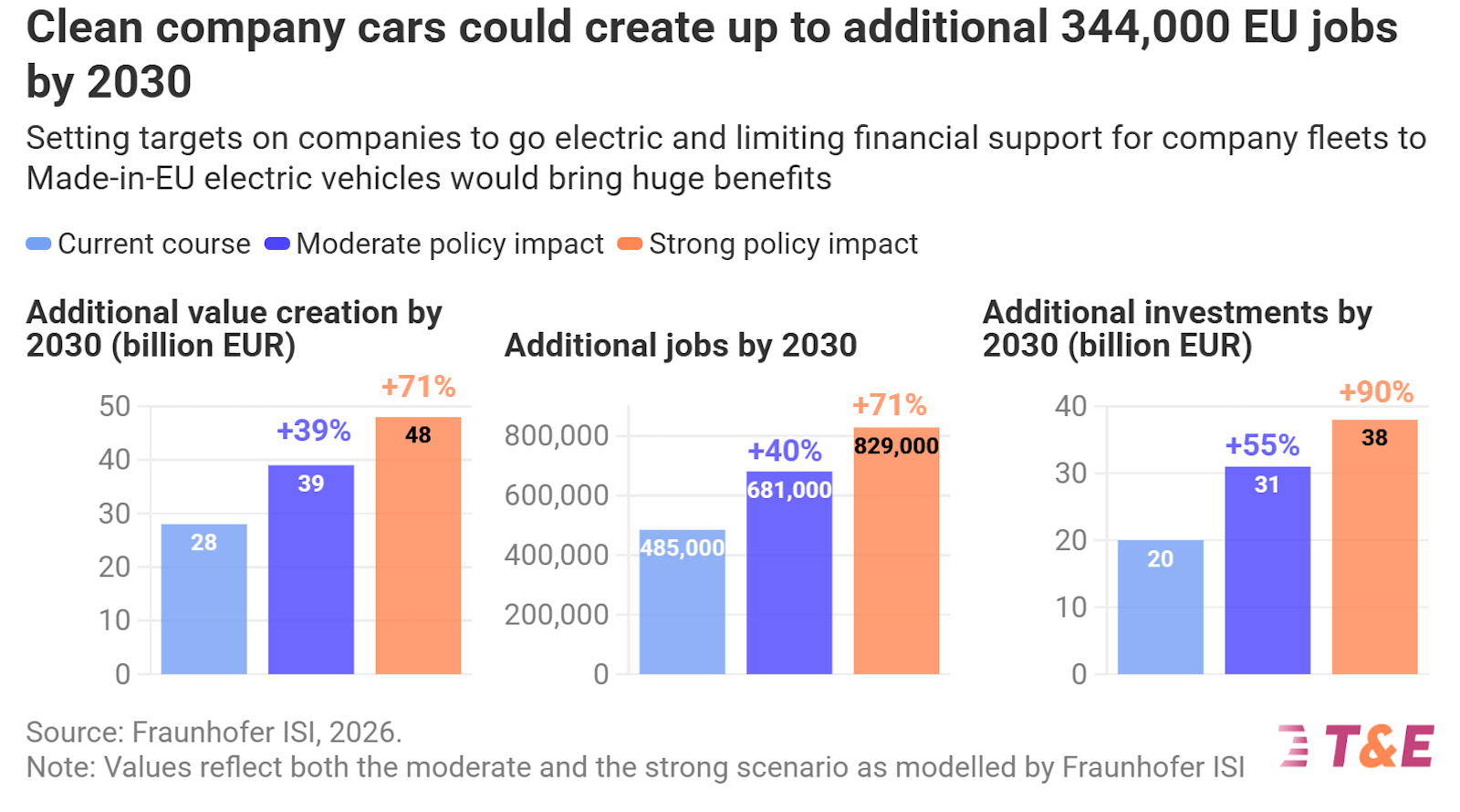
EU-wide electrification targets for giant fleets, mixed with limiting nationwide fiscal advantages solely to electrical Made-in-Europe firm automobiles, would convey 344,000 further jobs and €18 billion in additional funding to Europe’s economic system and automotive business by 2030, in response to a brand new T&E examine. Even beneath a average state of affairs, 196,000 jobs can be created.
The Clear Company Automobiles Regulation requires 45% of latest automotive gross sales in massive company fleets to be electrical by 2030. This establishes a minimal ground for fleet transition. Strictly limiting monetary assist for firm automobiles from January 2028 (Article 4 of the Regulation) to autos which might be low and 0 emissions and Made-in-Europe triggers the most important positive factors.
T&E evaluation exhibits that within the sturdy state of affairs, the place combustion automobiles are pushed out of firm fleets a lot sooner, 69% of latest automobiles in massive company fleets might be electrical by 2030, producing 344,000 further jobs. Financial positive factors may additionally soar from €28 bn to €48 bn, whereas investments may develop from €20 bn to €38 bn. Germany and Poland stand to reap the best advantages. Demand for extra jobs in Germany may rise by 134,000 (39% of the extra EU jobs), whereas Poland may seize 38,500 jobs extra.
Sofie Grande y Rodriguez, Clear Fleets Coverage Supervisor at T&E, mentioned: “Firm automobiles are the quickest solution to flip Europe’s EV transition into European jobs. Lawmakers have the chance to make the corporate automobiles regulation a key driver of Europe’s automotive competitiveness. Watering down its ‘Made-in-EU’ necessities would take away the inducement for carmakers to localise manufacturing . Equally necessary for securing at-risk jobs is retaining 2028 because the entry-into-force date.”
The query is not how briskly e-mobility strikes, however whether or not the EU is severe about competing with China, T&E warned. Failing to grab the demand potential of the regulation can be a historic misfire at a time when European carmakers may simply develop EV capability to guard jobs. Volkswagen serves as a living proof: whereas the group plans to chop 35,000 jobs by 2030, the brand new regulation alone may generate as much as 56,300 further direct jobs on the automaker over the identical period¹.
Past car manufacturing, the regulation would drive investments throughout the whole electrical car provide chain. In Poland, battery cell manufacturing may greater than double (31 GWh to 81 GWh) by 2030 and jobs may enhance by 38,500, 82% of which might be within the battery sector².
Sofie Grande y Rodriguez added: “Electrifying the fleets of huge corporations is vital to securing Europe’s EV worth chain and decreasing our dependence on dominant world suppliers. Europe already assembles most of its electrical firm automobiles. What it wants now’s assured demand, so the battery crops introduced right here really get constructed. To cease dropping floor to China on EVs, Europe should wager on Made-in-EU electrical firm automobiles”
NOTES TO EDITORS
¹ The Volkswagen case examine makes use of sturdy state of affairs outcomes.
² The Polish case examine additionally makes use of sturdy state of affairs outcomes.
Information launch from T&E.
Join CleanTechnica’s Weekly Substack for Zach and Scott’s in-depth analyses and excessive stage summaries, join our every day e-newsletter, and comply with us on Google Information!
Have a tip for CleanTechnica? Wish to promote? Wish to counsel a visitor for our CleanTech Discuss podcast? Contact us right here.
Join our every day e-newsletter for 10–15 new cleantech tales a day. Or join our weekly one on prime tales of the week if every day is simply too frequent.


CleanTechnica makes use of affiliate hyperlinks. See our coverage right here.
CleanTechnica’s Remark Coverage
