



Help CleanTechnica’s work by means of a Substack subscription, on Patreon, or on Stripe. Assist us produce all the high-quality, authentic content material we publish week after week regardless of the challenges of content-scraping AI, delinquent media, inflation, and different hurdles.
EVs and different electrical merchandise are rising not solely as a local weather technique but in addition as a query of affordability, financial competitiveness, public well being, client expertise, power safety, and resilience to unstable gasoline markets.
At 5 a.m., an electrical bus glides out of its depot after charging in a single day, prepared to hold youngsters to highschool with out spewing diesel fumes. As town stirs, warmth pumps have already introduced properties and places of work to a cushty temperature, utilizing far much less power than their gasoline boiler counterparts. By noon, solar energy prices supply autos, cools warehouses, and helps factories run their most energy-intensive processes. Then, as hundreds of thousands of individuals return dwelling and plug of their automobiles, good chargers quietly schedule charging for later, when electrical energy is cheaper and the grid much less busy.
Scenes like these are starting to emerge throughout the globe: electrical buses in Delhi, electrical warmth pumps warming properties by means of Norwegian winters, electrical vehicles coming into Chinese language freight and development fleets. The shift to electrification has begun.
Most individuals will expertise this transition not as an energy-system revolution, however as a quieter journey, a extra comfy dwelling, a decrease invoice, or cleaner air. However taken collectively, these on a regular basis modifications mark an epochal shift within the international economic system: from one constructed on burning fossil fuels to 1 pushed by clear electrical energy, environment friendly applied sciences, and versatile demand.
However what precisely is electrification? How can utilizing extra electrical energy profit folks and the planet? And what occurs when hundreds of thousands of recent electrical autos, home equipment, buildings, and factories connect with an influence system already beneath pressure?
Put merely, electrification means changing applied sciences that burn fossil fuels instantly—gasoline-fueled automobiles, diesel buses, gasoline boilers, industrial furnaces, and many others.—with alternate options powered by electrical energy. (Ideally clear electrical energy, however extra on that later).
This shift is transferring heart stage not solely as a local weather technique but in addition as a query of affordability, financial competitiveness, public well being, client expertise, power safety, and resilience to unstable gasoline markets.
But the case for electrification is extra compelling—and extra attention-grabbing—than merely switching fuels. To grasp its potential, we first want to have a look at how far electrification has progressed, why electrical applied sciences use much less power and are cheaper to run, and what must occur to make sure electrification brings about societal and environmental advantages. Right here, we dive deep into the present state of electrification and the best way to speed up it in the precise manner.
What’s the Present State of Electrification Globally?
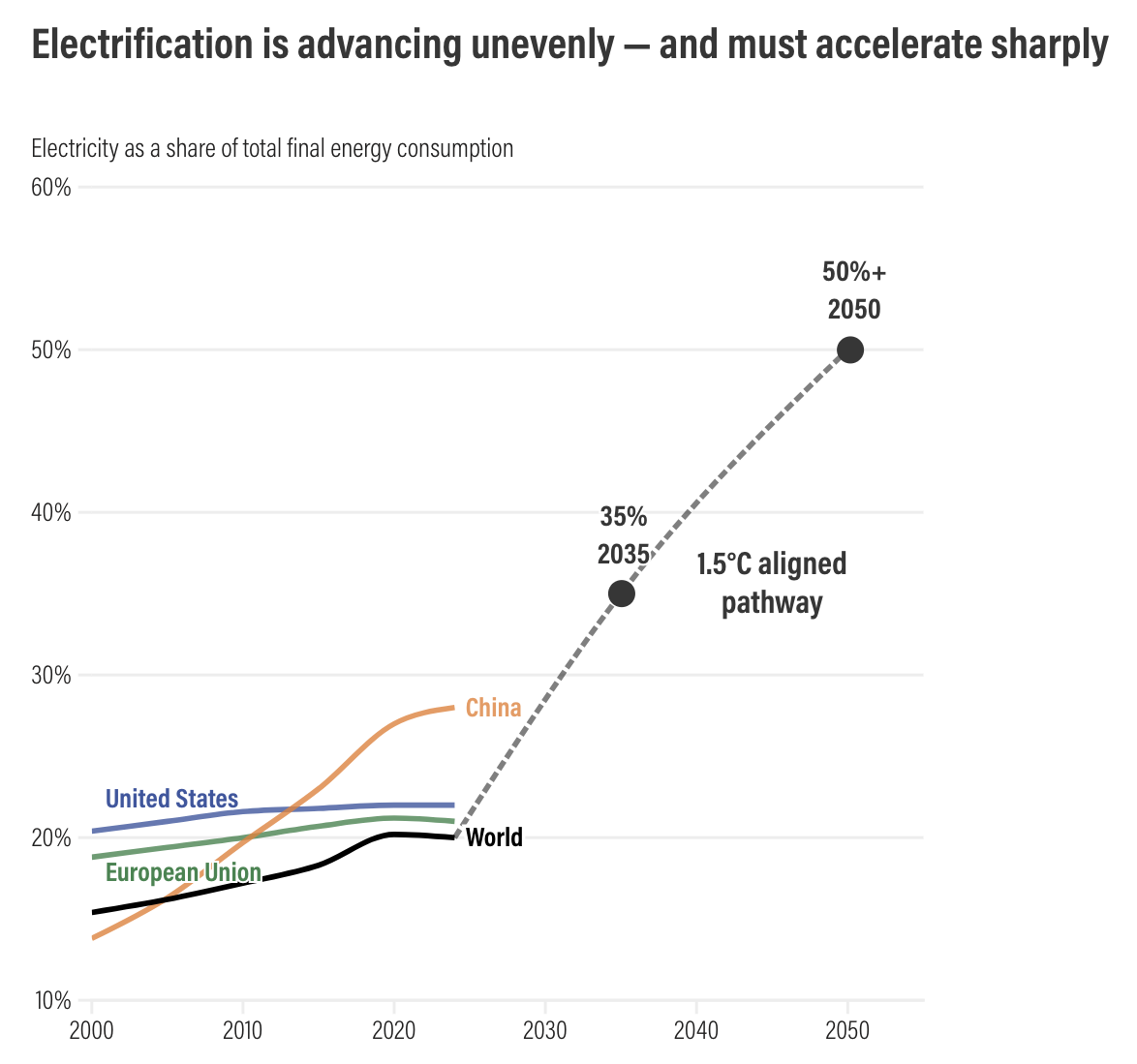
The reply relies upon closely on the place (and what) you have a look at. In some applied sciences and markets, electrification is advancing remarkably shortly. Throughout the broader international economic system, nevertheless, electrical energy nonetheless provides solely about 20% of ultimate power use (the power really consumed in properties, companies, autos, and factories).
Highway transport is at the moment the clearest instance of electrification gathering tempo. World electrical automotive gross sales have elevated by nearly 600% since 2020, rising to twenty million final yr and now accounting for multiple in 4 new automobiles offered. Transport is advancing quicker than buildings and heavy business, however most autos already on the street proceed to burn fossil fuels.
Progress additionally differs sharply throughout geographies. China, typically dubbed “the primary electro-state,” has pulled forward, with electrical energy now supplying nearly 30% of ultimate power use, versus roughly 22% in the USA and 21% within the European Union.
At present’s tempo continues to be removed from adequate. In response to the Worldwide Renewable Vitality Company, electrical energy should provide greater than half of all last power use by mid-century to carry international temperature rise to 1.5 levels C (2.7 levels F), the restrict scientists say is important for averting a number of the worst impacts of local weather change. That should include a profound shift in how electrical energy is generated, with renewables offering round 90% of worldwide energy. Electrification and energy sector decarbonization should subsequently advance collectively.
Why Is Progress Uneven?
A part of the reason lies in how dispersed the transition is. Energy sector choices are concentrated amongst utilities, builders, regulators, and governments, whereas end-use electrification reaches into hundreds of thousands of properties, autos, companies, and manufacturing strains.
In the meantime, some actions are merely more durable to affect than others. Electrical applied sciences can already serve street transport, buildings, and plenty of lower-temperature industrial processes. In lots of circumstances, they’re already cheaper to function than their fossil fuel-powered counterparts and may ship decrease lifetime prices even the place the upfront worth stays greater. Electrical automobiles and buses, warmth pumps, induction cookers, electrical water heaters and plenty of industrial motors are more and more out there and inexpensive.
However for industries like steelmaking or chemical manufacturing, and for sectors resembling aviation and delivery, direct electrification is more durable. These actions require extraordinarily excessive temperatures, use fossil fuels as a uncooked materials within the manufacturing course of, or want extra power than right now’s batteries can effectively carry. In these circumstances, hydrogen, artificial fuels, or different low-carbon alternate options could also be extra viable alternate options than electrification, whereas carbon seize could also be wanted for residual emissions that can’t simply be averted.
“Electrify Every thing!” is likely to be a tempting slogan, however it’s unlikely to be pragmatic—and even fascinating—as an financial or industrial technique. The extra wise (if admittedly much less catchy) goal is to affect instantly within the many areas it makes overwhelming sense to take action, whereas reserving scarcer alternate options for the trickier-to-electrify sectors.
What’s the Environmental Benefit of Electrification?
Electrification is an enabler, not an finish objective in itself. An electrical automotive powered by a coal-heavy grid may very well be worse for the local weather than a automotive that runs on gasoline. Its profit, in different phrases, will depend on how the electrical energy is generated. However an electrical automotive, warmth pump, or industrial course of can turn into ever-cleaner over time because the grid decarbonizes by means of better use of wind, photo voltaic, nuclear, or different clear power sources. A gas-powered engine or boiler, against this, stays locked into burning polluting fuels all through its life. The total good thing about electrification subsequently solely comes from increasing electrical finish makes use of whereas additionally making the ability provide progressively cleaner.
Moreover, one among electrification’s most counterintuitive options is that electrical energy consumption can rise whereas general power use falls.
The reason being effectivity. Combustion engines waste as a lot as 80% of their gasoline’s power (principally as warmth), changing simply 20% into helpful movement. In the meantime, electrical motors convert round 80% of their electrical power into movement. Warmth pumps go even additional. Quite than creating warmth by burning gasoline, they extract current warmth from the air or floor, sometimes delivering a number of models of warmth for every unit of electrical energy consumed.
Changing applied sciences that burn gasoline instantly with electrical alternate options—changing molecules with electrons—can subsequently scale back the power required to make the identical journey or warmth the identical dwelling.
This produces a second obvious paradox: your electrical energy invoice could get larger whereas your whole power invoice will get smaller. An electrified family makes use of extra electrical energy, in fact; however its occupants now not purchase gasoline for his or her automobiles or heating programs. As a result of EVs and warmth pumps use power way more effectively than combustion engines and boilers, the averted gasoline prices can greater than offset the extra energy consumed, even when electrical energy itself turns into costlier. For instance, one current evaluation estimated that totally electrifying a typical European family’s heating and transport may lower its general power invoice by greater than half.

Past Lowering Emissions and Vitality Use, What Advantages Does Electrification Provide?
The case for electrification can not — and needn’t — relaxation on emissions reductions alone (though you may assume that preserving a livable planet is a sufficiently persuasive start line!).
Transitions transfer quicker when the brand new know-how shouldn’t be merely cleaner however visibly higher for folks and companies. EVs are quieter, smoother, sometimes cheaper to run, and extra responsive than gas-powered automobiles, with instantaneous acceleration from a standstill. Warmth pumps can present heating and cooling from the identical system. Electrical cooking improves indoor air high quality and provides better temperature management. Electrical industrial gear could make manufacturing extra exact, responsive, and environment friendly. And all these applied sciences may also help scale back prices by utilizing power extra effectively.
However a greater know-how shouldn’t be robotically a greater proposition for everybody. Upfront prices, entry to infrastructure, and the best way electrical energy is priced can decide which households and companies profit. A rich home-owner with a driveway should purchase an EV upfront and set up a charger; a supply driver in Nairobi might have inexpensive finance, battery swapping, and dependable public charging. A well-insulated constructing can use a warmth pump effectively; a poorly insulated one could require expensive upgrades earlier than a warmth pump is smart.
So whereas know-how creates the potential, it’s the infrastructure, finance, and coverage that decide who can understand it. In Rwanda, for instance, insurance policies like tax incentives alongside non-public financing and battery-swapping networks are serving to bike taxi drivers swap to electrical bikes. The shift cuts day by day gasoline and upkeep prices for drivers whereas additionally bettering town’s air high quality and supporting the nation’s goal of electrifying 30% of its two-and three-wheelers by 2030.
Can the Grid Actually Help Extra Electrification as Energy Demand Surges?
Electrical energy demand is already hovering, pushed by elevated cooling wants, knowledge facilities, industrial development, and wider entry to dependable energy. Add hundreds of thousands of electrical autos, warmth pumps, and industrial machines with out planning the place and when they’ll draw energy, and right now’s bottlenecks will worsen.
Electrification is subsequently not solely an influence technology problem. Additionally it is a grid and coordination problem, requiring motion on three fronts:
- First, get extra from the system already in place. Higher knowledge, smarter controls, storage and selective gear upgrades may also help operators transfer extra energy by means of current networks and make higher use of capability that may in any other case sit idle.
- Second, develop grid capability quicker and extra strategically. Utilities want the boldness and regulatory mandate to take a position forward of predictable demand. Connection processes, allowing and gear requirements want reforming to get quicker.
- Third, change when and the place energy demand hits. The situation, timing and suppleness of a brand new bus depot, knowledge heart or manufacturing unit can materially have an effect on how a lot grid infrastructure is required, who else can join and when.
Contemplate a metropolis planning each hundreds of recent properties and a big electrical bus fleet. If the housing authority, transport company and utility plan individually (as they so usually do), transformers could also be upgraded twice, depot connections delayed and residents left ready for each housing and cleaner transport. Plan them collectively — alongside native photo voltaic, batteries and bidirectional charging and controls — and the identical funding can assist a number of public priorities whereas concurrently creating on-demand native energy-storage property.
Constructing clear technology is pointless if prospects can’t connect with it. Constructing new grid infrastructure is wasteful if current capability stays poorly used. Strategic electrification requires each enlargement and a lot sharper coordination throughout energy, transport, buildings, business and concrete growth.
How Do We Shift from Passive Electrical energy Consumption to Energetic Demand?
Now image 6 p.m. in that very same, more and more electrified metropolis I discussed in the beginning of this text. Hundreds of households arrive dwelling and all start cooking dinner. Vehicles are plugged in. Heating or cooling continues to be operating, outlets are nonetheless open, factories are nonetheless producing and knowledge facilities are nonetheless computing. The issue shouldn’t be essentially a scarcity of electrical energy throughout the entire system. It’s that an excessive amount of demand arrives in the identical components of the grid on the similar second. Networks pressure, costly backup technology switches on and billions get spent constructing infrastructure wanted for only some hours every year.
But a lot of that demand is versatile.
A automotive could also be parked all night time however want only some hours to cost. Buildings can pre-heat or pre-cool earlier than peak electrical energy demand. Water heaters, refrigerated warehouses, batteries and a few industrial processes may run just a little earlier or later, shifting demand — and all with out disrupting consolation or output.
None of this requires folks to reorganize their evenings or turn into novice electrical energy merchants. They merely need their automobiles charged, their properties comfy and their payments decrease.
Sensible controls can optimize power use robotically. A buyer may choose in to a program run by their power provider, which quickly adjusts their thermostat, EV charger and/or water heater when electrical energy demand is especially excessive — sometimes with none noticeable lack of consolation or comfort. The client retains final management and may override the change whereas receiving a decrease invoice or cost in return. Carried out effectively, this creates a triple-win: decrease payments for the shopper, much less pressure on the grid and fewer costly investments.
At a constrained time and place, a megawatt of demand that may be shifted in time could also be extra helpful than a megawatt of extra provide. It may well relieve a bottleneck instantly, scale back renewable curtailment (when renewable power manufacturing is deliberately decreased as a result of the grid doesn’t have the capability to deal with it or as a result of there may be not sufficient demand for it), and keep away from constructing infrastructure used for under a handful of hours every year.
The Expertise Exists. So What’s Lacking?
First, the electrical energy system must know what versatile property can be found and once they can reply. A grid operator can not depend on hundreds of particular person EV chargers, batteries or business fridges if it can not see the place they’re, how shortly they’ll react, or how a lot demand they’ll shift. These many smaller property additionally want a easy route into the market (usually by being grouped collectively by an “aggregator”). They usually must be paid for the worth they supply.
Second, utility incentives set by regulators matter. A utility that earns extra for constructing new substations and cables — as is commonly the case — will have a tendency to construct. If it’s also rewarded for utilizing batteries, good charging and versatile demand to resolve the identical drawback extra cheaply, it’s incentivized to decide on one of the best mixture.
Third, the enterprise mannequin has to stack up. Batteries, good controls and versatile industrial gear won’t scale on one-off grants or short-lived pilots. Traders want predictable revenues, prospects want inexpensive finance for the upfront prices and repair suppliers want confidence that market guidelines will survive lengthy sufficient to construct a viable enterprise.
The subsequent part of electrification is much less about inventing some technological silver bullet than about governments, regulators and system operators creating the market guidelines, incentives and income streams that enable current applied sciences to scale. In follow, which means treating flexibility as an actual system useful resource — and paying for the worth it offers.
Electrify Extra, Sure. However Additionally Electrify Higher
Again to our metropolis instance one final time, however 15 years on.
The buses are all electrical, however that’s solely essentially the most seen change. Depots cost primarily when energy is affordable and plentiful. Vitality saved of their batteries is on the market for back-up energy throughout emergencies like storms. Condo buildings share chargers slightly than reserving e-mobility for folks with driveways. Houses keep comfy by means of heatwaves and chilly spells as a result of environment friendly buildings, warmth pumps, thermal storage and good controls work collectively, pre-heating or pre-cooling when clear energy is plentiful, easing demand when the grid is strained and serving to keep important providers throughout blackouts. Eating places and faculties cook dinner with out indoor combustion and the ensuing air pollution.
The commercial district has modified, too. Electrical boilers, motors and warmth pumps use power extra exactly, whereas versatile processes resembling refrigeration, water heating or pumping robotically run earlier or pause briefly when the grid is beneath pressure. New factories deliberately select websites the place clear energy and community capability can be found. Information facilities and different massive power customers safe connections partly by bringing storage, clear on-site technology and suppleness that profit the broader system.
For shoppers, a lot of that is invisible. Their automotive is prepared within the morning. Their constructing stays comfy. Their power supplier shifts versatile consumption within the background and returns a number of the financial savings. Throughout an influence disruption, batteries in buses, properties and business buildings assist maintain crucial providers operating.
For the economic system, the shift is deeper. Cash as soon as spent importing, subsidizing, and burning oil and gasoline is redirected into productive property at dwelling: clear technology, grids, environment friendly buildings, autos, storage, software program and industrial gear. As an alternative of frequently paying for imported fuels, nations construct lasting home capability, strengthen industrial resilience and achieve better management over their power future.
The prize is subsequently bigger than emissions discount. It’s higher services, cleaner air, decrease prices, stronger power safety and better nationwide management over the power provide.
Electrification, then, shouldn’t be merely about changing one gasoline with one other, or including ever-more demand to the grid. It’s about transferring from an power system constructed round inefficient, polluting combustion to 1 constructed round clear electrical energy, environment friendly applied sciences and demand that may reply intelligently to the system round it.
Electrify extra, sure. However above all, electrify higher.
EVs and different electrical merchandise are rising not solely as a local weather technique, however as a query of affordability, financial competitiveness, public well being, client expertise, power safety and resilience to unstable gasoline markets.
By Clem Perry, courtesy of WRI.
Join CleanTechnica’s Weekly Substack for Zach and Scott’s in-depth analyses and excessive stage summaries, join our day by day e-newsletter, and comply with us on Google Information!
Have a tip for CleanTechnica? Wish to promote? Wish to counsel a visitor for our CleanTech Speak podcast? Contact us right here.
Join our day by day e-newsletter for 10–15 new cleantech tales a day. Or join our weekly one on high tales of the week if day by day is simply too frequent.


CleanTechnica makes use of affiliate hyperlinks. See our coverage right here.
CleanTechnica’s Remark Coverage
