



Help CleanTechnica’s work by a Substack subscription, on Patreon, or on Stripe. Assist us produce the entire high-quality, authentic content material we publish week after week regardless of the challenges of content-scraping AI, delinquent media, inflation, and different hurdles.
The electrical-aviation contest is usually introduced as a race between plane startups. That’s in all probability the flawed unit of study. An airplane that flies as soon as, wins a certification milestone or accumulates a big order e book has demonstrated one thing helpful, however it has not demonstrated an business. What issues is whether or not operators can put a whole lot of plane into common passenger and cargo service, keep them, cost them, change their batteries economically, order a second fleet after seeing the actual working prices and finally promote the system overseas.
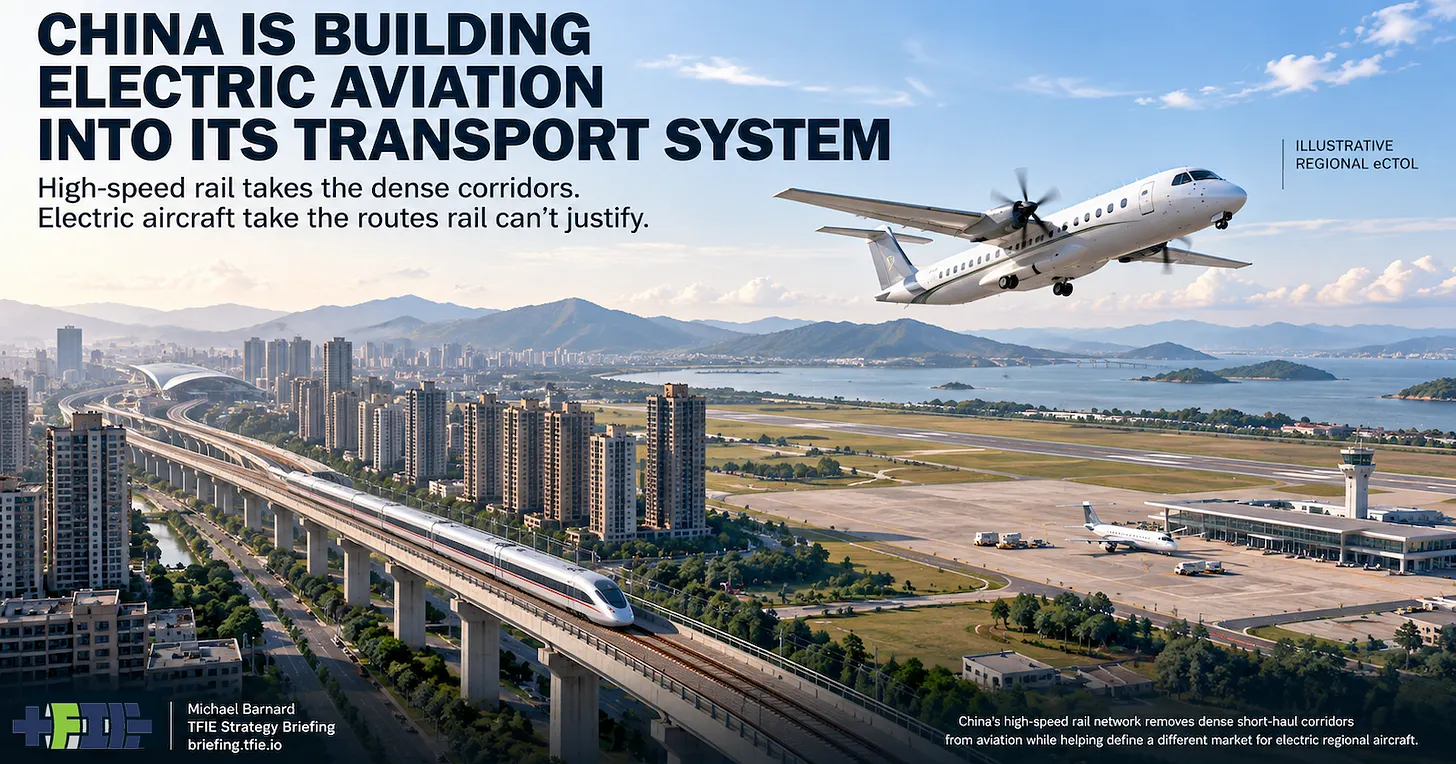
China is unusually nicely positioned for that take a look at as a result of it’s not approaching electrical aviation as an remoted plane downside. Its transport system is already eradicating lots of the routes that plane serve poorly. China’s high-speed rail community reached about 50,400 kilometres by the top of 2025 and is predicted to strategy 60,000 kilometres by 2030. Dense metropolis pairs can stay rail markets, leaving thinner regional routes, islands, troublesome terrain, cargo hyperlinks and poorly related cities as a extra clearly outlined aviation alternative.
That is a crucial inversion. Seen from an plane producer’s gross sales division, each profitable high-speed rail line removes potential passengers. Seen from a transport ministry, rail and aviation have totally different jobs. China doesn’t want battery plane to compete with 350 km/h trains between dense main cities. It wants them to develop into the higher transport product on routes the place one other railway has poor economics and traditional regional aviation stays too costly or rare.
The complete evaluation in TFIE Technique Briefing goes deeper into the battery techniques, COMAC and AECC packages, CAAC’s working framework, the Western countercase and the export pathways that might flip early home fleets into an business.
The brink for “scale” must be correspondingly demanding. A fleet of electrical trainers will not be the identical factor as a regional passenger market. Just a few backed demonstration routes don’t show utilization or upkeep economics. The stronger proof could be a whole lot of runway-based electrical or hybrid plane flying repeated schedules, batteries reaching anticipated alternative intervals, operators understanding actual upkeep prices, second orders arriving and overseas operators doing the identical.
China already has a small however actual licensed electric-aircraft base, however that’s not the central benefit. Europe licensed the Pipistrel Velis Electro in 2020, so China is hardly alone in getting electrical plane by certification. The extra essential distinction is industrial context. The IEA says China produced greater than 80% of worldwide battery cells in 2025, together with even bigger shares of some key energetic supplies. Aviation batteries have a lot harder mass, security, energy and lifecycle necessities than automotive packs, however electrical plane builders in China can specialize an industrial base constructed for markets orders of magnitude bigger than aviation.
CATL makes the excellence clear. The corporate has publicized an aviation-oriented condensed cell at as much as 500 Wh/kg, an eye catching quantity that turns into a lot much less helpful if handled as an put in aircraft-system specification. Actual plane batteries additionally require containment, thermal administration, electrical safety, battery administration, construction, reserves and sufficient energy late in a flight. CATL’s newer aviation work consists of certification-oriented security testing on a lower-specific-energy configuration, proof that the corporate is working each the energy-density and integration sides moderately than merely publishing a laboratory quantity.
Coverage issues as a result of plane alone don’t create scheduled transport. China’s Inexperienced Aviation Manufacturing Growth Define for 2023–2035 explicitly consists of electrical propulsion, aviation batteries and the techniques wanted to combine them into civil plane. CAAC’s short-haul aviation working framework offers with the boring however important items—routes, schedules, airport integration, passenger service and working oversight. That issues extra to an actual transport market than one other spectacular prototype flight as a result of airports want energy, airways want dependable charging home windows, crews and upkeep organizations want coaching, and regulators want expertise with battery and propulsion failure modes.
China’s state aerospace business can be collaborating moderately than leaving the sector fully to venture-backed startups. COMAC-associated packages are doing electric-propulsion and plane integration work, whereas AECC describes a megawatt-class hybrid propulsion system supposed for functions extending into next-generation regional plane. None of that establishes a licensed 70- or 90-seat hybrid airliner at the moment. It establishes that the troublesome bridge from small battery plane towards bigger regional techniques is already contained in the work packages of organizations answerable for China’s wider aerospace functionality.
The Western countercase is powerful sufficient that this stays a forecast moderately than a foregone conclusion. Coronary heart Aerospace’s X1 demonstrator flew for 27 minutes in August 2026, at greater than 25,000 kilos takeoff weight with over one megawatt of electrical propulsion. Europe has licensed electrical propulsion {hardware}, established airframers and severe testing environments. Airbus, ATR, Embraer, Safran, Pratt & Whitney Canada, Collins and others have deep aerospace expertise China remains to be constructing.
China’s benefit is that it might probably join these items right into a deployment system quicker. Its batteries come from an infinite manufacturing base, its regulator has specific institutional causes to construct experience, its state aerospace organizations can stay concerned by a number of improvement cycles, and its transport system already separates dense rail corridors from routes the place smaller plane can add extra worth.
Exports could be the stronger take a look at. China doesn’t want FAA or EASA validation earlier than an electrical plane can develop into commercially related outdoors China. COMAC has already demonstrated the broader precedent: by early 2026, C909 plane have been working commercially in Southeast Asia, supported by certification acceptance, leasing, coaching, upkeep and working assist. Electrical plane are extra depending on batteries and charging infrastructure, however the industrial precept is analogous. The export product is not only an airframe; it’s the plane, floor energy, battery assist, spares, upkeep, coaching, finance and regulatory acceptance collectively.
That’s the reason the subsequent prototype flight will not be essentially the most attention-grabbing milestone. Look ahead to delivered plane getting into repeated service, utilization accumulating, battery alternative intervals turning into seen, operators putting second orders and overseas fleets following home ones. These occasions would present that China had crossed the road from electric-aircraft improvement into an electric-aviation business.
China has not crossed that line but. It has, nonetheless, assembled extra of the encircling industrial and transport system than every other nation at present pursuing it. If a whole lot of helpful plane enter routine service, second orders comply with and exports start accumulating working historical past, the argument can have moved from industrial forecast to demonstrated management.
Learn the complete techniques evaluation in TFIE Technique Briefing.
Join CleanTechnica’s Weekly Substack for Zach and Scott’s in-depth analyses and excessive stage summaries, join our every day publication, and comply with us on Google Information!
Have a tip for CleanTechnica? Wish to promote? Wish to counsel a visitor for our CleanTech Discuss podcast? Contact us right here.
Join our every day publication for 10–15 new cleantech tales a day. Or join our weekly one on high tales of the week if every day is just too frequent.

CleanTechnica makes use of affiliate hyperlinks. See our coverage right here.
CleanTechnica’s Remark Coverage
