



Help CleanTechnica’s work by a Substack subscription, on Patreon, or on Stripe. Assist us produce the entire high-quality, authentic content material we publish week after week regardless of the challenges of content-scraping AI, delinquent media, inflation, and different hurdles.
Europe’s inland-shipping fashions underprice renewable diesel. For a brand new 110-meter dry-cargo vessel, PLATINA4Action calculates HVO (hydrotreated vegetable oil) propulsion at €1,798/day in opposition to €1,964/day for battery swapping. Apply the noticed October 2026 Dutch HVO market worth, together with supply, and the HVO value is €2,515/day. Battery swapping is €551/day cheaper. The mannequin’s declare of an HVO value benefit fails a market-price verify.
The hole between the modeled HVO worth and noticed market costs issues for the funding decisions these research inform. It additionally exposes a wider sample. European research give renewable liquid fuels favorable future costs whereas anticipating marine batteries to stay costly for for much longer than the broader battery market suggests.
The Central Fee for the Navigation of the Rhine (CCNR) commissioned the unique transition examine behind its 2021 roadmap. Its situations influenced subsequent work, together with the EU-linked PLATINA4Action and SYNERGETICS tasks. These tasks don’t all use equivalent fashions, however their assumptions and proposals contribute to a shared coverage image through which a number of combustion pathways are anticipated to stay aggressive with direct electrification.
Within the full TFIE evaluation, I transformed the October 2026 Dutch Class II HVO wholesale benchmark, added a supply allowance and expressed the lead to 2025 euros. The market-based HVO value is €2.59/kg. Battery swapping turns into cheaper than HVO within the PLATINA4Action 110-meter vessel comparability at roughly €1.93/kg. At that noticed market worth, modeled HVO propulsion prices €2,515/day over the mannequin’s 2028–2047 possession interval, in opposition to €1,964/day for swapping. The mannequin places fossil diesel at €1,844/day, leaving swapping about 7% above diesel however 22% beneath market-priced HVO.
The value distinction issues to freight operators. CCNR’s 2026 value indices allocate gas 35% of dry-bulk prices, 30% of tanker prices and 28% of container transport prices. Operators compete for cargo in opposition to rivals nonetheless burning diesel. Costly different fuels can’t be handed by to clients merely as a result of a transition situation requires them.
An April 2025 assertion from European inland transport and port organizations known as for sufficient HVO at diesel-competitive costs to produce 1.6 million tons yearly by round 2030. That amount roughly matches the sector’s complete typical diesel consumption in 2015. It exceeds the EU’s 2025 sustainable aviation gas provide of 1.1 million tons by about 45%.
HVO and traditional biodiesel compete for oils and fat additionally used to supply aviation gas. Aviation has fewer sensible routes to electrification, and its European mandates create demand for renewable kerosene. An HVO-centered inland technique places barges in direct competitors with plane for constrained feedstocks, even the place barges can draw electrical energy from a hall community.
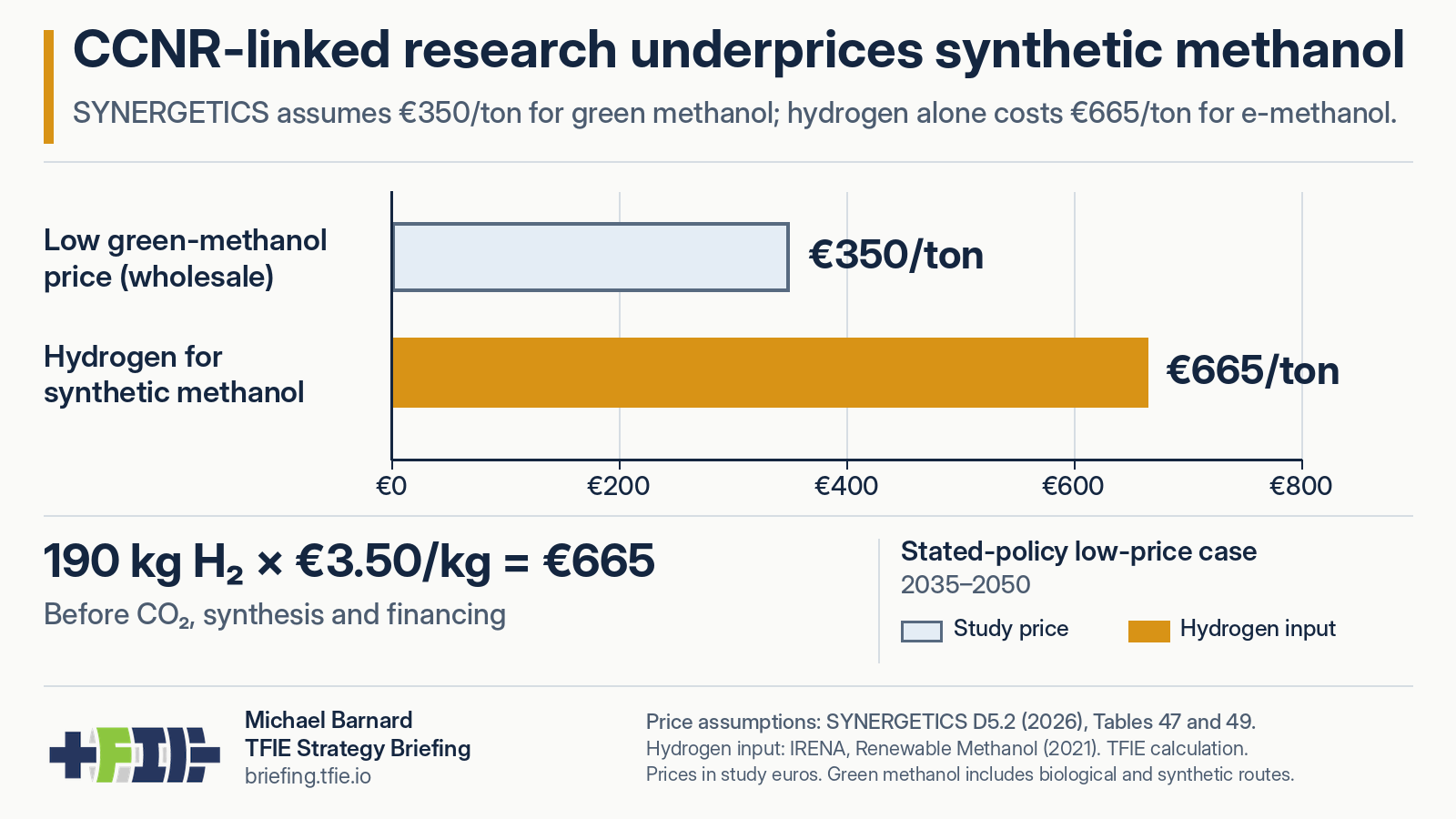
Artificial fuels current a fair sharper drawback. SYNERGETICS provides inexperienced methanol from organic and artificial routes a mixed low wholesale worth of €350/t in its stated-policy case from 2035. That very same situation makes use of a low green-hydrogen worth of €3.50/kg. Producing a ton of artificial methanol takes about 190 kilograms of hydrogen, costing €665 earlier than carbon dioxide, synthesis, financing and supply. The hydrogen enter alone prices nearly twice the assumed low finished-fuel worth.
Biomethanol is a unique manufacturing route. It may be comprised of agricultural and forestry residues, and I count on it to play a helpful position in deep-sea transport. Grouping organic and artificial methanol collectively conceals the economics of every. For inland waterways, the related competitor is usually electrical energy delivered on to the propeller, not fossil methanol changed with greener methanol.
The battery forecasts lean in the other way. SYNERGETICS locations 2030 marine battery storage at €210–€520/kWh, a €365 midpoint. My inland freight electrification report fashions standardized marine battery containers at €100/kWh in 2030, together with the marine security and container methods, with vessel integration costed individually. A €265/kWh distinction provides €1.06 million to a 4 MWh battery set up earlier than working the vessel. The total fleet-level evaluation additionally costs spare batteries, financing, charging infrastructure and gear held in reserve.
The research’ fleet assumptions compound the fuel-price decisions. One PLATINA4Action case requires a big Rhine or Danube pusher to go seven days with out replenishing power, excluding intermediate charging or trade from the check. The SYNERGETICS SYNFEED mannequin begins each new vessel with a Stage V combustion engine, leaving electrification to later retrofits. These are consequential design decisions for a transition modeled by 2050.
Freight demand needs to be modeled earlier than gas demand. Mineral oil merchandise, coal and iron ore accounted for 35.7% of Rhine cargo mass in 2025. CCNR’s personal underlying financial projections level towards massive declines in coal, refining and first metals, at the same time as development and commerce develop. The quantity and composition of freight needing propulsion in 2050 will differ from at present’s cargo combine.
The Netherlands has already lowered its 2040 hydrogen demand expectations and recognized electrical energy as the principle inland-shipping pathway towards 2050. CCNR is revisiting its transition work. The brand new evaluation ought to begin with the freight that may really transfer, calculate route power and charging or trade wants, after which check the remaining gas demand in opposition to costs reflecting aviation, deep-sea transport and industrial competitors.
Know-how neutrality is a technique of evaluating options, not an obligation to finance each gas pathway. With HVO priced in opposition to market proof and batteries costed realistically, the funding case for parallel gas infrastructure weakens.
The total TFIE Technique Briefing evaluation walks by the CCNR, PLATINA4Action and SYNERGETICS value assumptions, the HVO crossover and the synthetic-fuel arithmetic. The open inland freight electrification report comprises the route, fleet and infrastructure mannequin.
Subscribe to TFIE Technique Briefing for unbiased assessments of the prices and strategic decisions shaping decarbonization.
Join CleanTechnica’s Weekly Substack for Zach and Scott’s in-depth analyses and excessive degree summaries, join our day by day e-newsletter, and observe us on Google Information!
Have a tip for CleanTechnica? Wish to promote? Wish to counsel a visitor for our CleanTech Speak podcast? Contact us right here.
Join our day by day e-newsletter for 10–15 new cleantech tales a day. Or join our weekly one on prime tales of the week if day by day is just too frequent.


CleanTechnica makes use of affiliate hyperlinks. See our coverage right here.
CleanTechnica’s Remark Coverage
