



Assist CleanTechnica’s work via a Substack subscription, on Patreon, or on Stripe. Assist us produce the entire high-quality, unique content material we publish week after week regardless of the challenges of content-scraping AI, delinquent media, inflation, and different hurdles.
Nearly 8 months into Trump’s battle on Iran, we will see extra clearly the results of this quagmire. Some have been fairly sudden, just like the shocking resilience of the oil market, the emergence of a number of failure factors exterior of Hormuz (together with Bab-al Mandeb, the East-West pipeline, and world refinery capability), and the elevated threat of regionalization for the battle. These points have little question taken lots of analysts abruptly.
Others, like Trump’s reluctance to confess he tousled, have been fairly anticipated.
However right now I wish to speak about one thing else. I imagine this battle has both brought about or displayed a seismic change in the best way world oil markets work. I imagine that for the primary time since oil is a factor, oil demand is changing into elastic.
And since to this point I haven’t seen anybody make this declare, I needed to place my speculation up for debate.
A Story of Demand
When talking about demand, economists usually use the phrases elastic and inelastic to find out how a lot consumption will fluctuate when costs go up or down.
Some issues, reminiscent of meals staples, are consumed at fairly steady ranges. Individuals will hold consuming roughly the identical no matter their financial state of affairs (until very, very dire), and likewise, individuals who turn out to be wealthier are unlikely to eat rather more: somebody who simply bought a job paying double isn’t going to all of the sudden purchase twice as many potatoes. Which means meals demand is taken into account inelastic. Be mindful this works the opposite method round: if potatoes all of the sudden halve in worth, it’s unlikely that somebody will all of the sudden begin consuming double the quantity of them.
Different issues, reminiscent of airplane tickets, are extra depending on their worth and the disposable revenue of customers. Individuals who all of the sudden get a greater job at very more likely to take a costlier trip or select to fly as an alternative of driving (or taking a bus) to avoid wasting time. Likewise, if airplane tickets turn out to be cheaper, extra folks will select to fly, and they’ll fly extra typically. Due to that, airplane ticket demand is taken into account elastic.
(I apologize to all of the economists studying this if my examples are too easy or in any other case dumb, however these have been the very best concepts I had in thoughts.)
For a really, very very long time, oil demand has been thought-about inelastic. Since folks have to commute to their jobs, go to their family members, and transfer merchandise round no matter revenue or oil costs, oil consumption has remained roughly fixed (with an inclination to extend over time), with demand rising a bit sooner if oil is reasonable and a bit slower if oil is pricey. On this context, oil demand has traditionally required an financial disaster to go down: both the economic system slows down for unrelated causes and oil demand falls with financial exercise usually (as occurred throughout the 2008 subprime disaster), or oil costs go up a lot that they trigger a recession, solely falling again down once more via lowered financial exercise (as occurred throughout the 1973 and 1979 oil disaster).
However our world is altering, and I’ve motive to imagine that oil demand is falling increasingly more into the elastic a part of the equation.
To get to this conclusion, although, we first have to have a look at the present state of the oil market.
A messy, declining market
Out of the three most important establishments following the worldwide oil market (OPEC, IEA and EIA), two — the EIA and IEA — undertaking a decline in world oil consumption of over 2 million barrels a day (mbd) whereas the third — OPEC — initiatives a slight enhance. It goes with out saying that I belief rather more within the first two, as OPEC tends to be a bit … ahem, “optimistic” in terms of the way forward for oil.
However I digress. The purpose right here is that, based on essentially the most dependable sources round, world oil consumption will fall by between two and three million barrels a day in 2026, a primary because the pandemic years.
By itself, that is already extremely related. That is the primary time since ever that we’re seeing oil demand falling absent a generalized financial disaster or in any other case some kind of disaster (reminiscent of COVID). Even when a disaster is coming, the truth that oil consumption goes down earlier than a recession implies that one thing has basically modified within the oil market. Each different time this occurred (1974–75, 1980–83, 2009, 2020), we had an financial disaster as oil demand fell.
But, essential as this can be, it merely factors to the truth that the economic system is much less depending on oil than ever. To get to the half the place demand turns into elastic, we should take a look at a unique a part of the equation.
A matter of worth
For this half, we’d usually take a look at oil costs. Nevertheless, because the oil market is a large number, and oil costs are probably decrease than they might in any other case be because of vital disruptions on transport and refinery capability, we’ll concentrate on gasoline and diesel costs to the patron as a proxy for a extra “actual” value of oil.
For this, we’ll use the EIA historic monitor on gasoline costs within the US, a globalized market with costs largely monitoring world circumstances, and we’ll concentrate on any interval prior to now wherein gasoline and diesel costs have surpassed $4/gallon (adjusted for inflation):
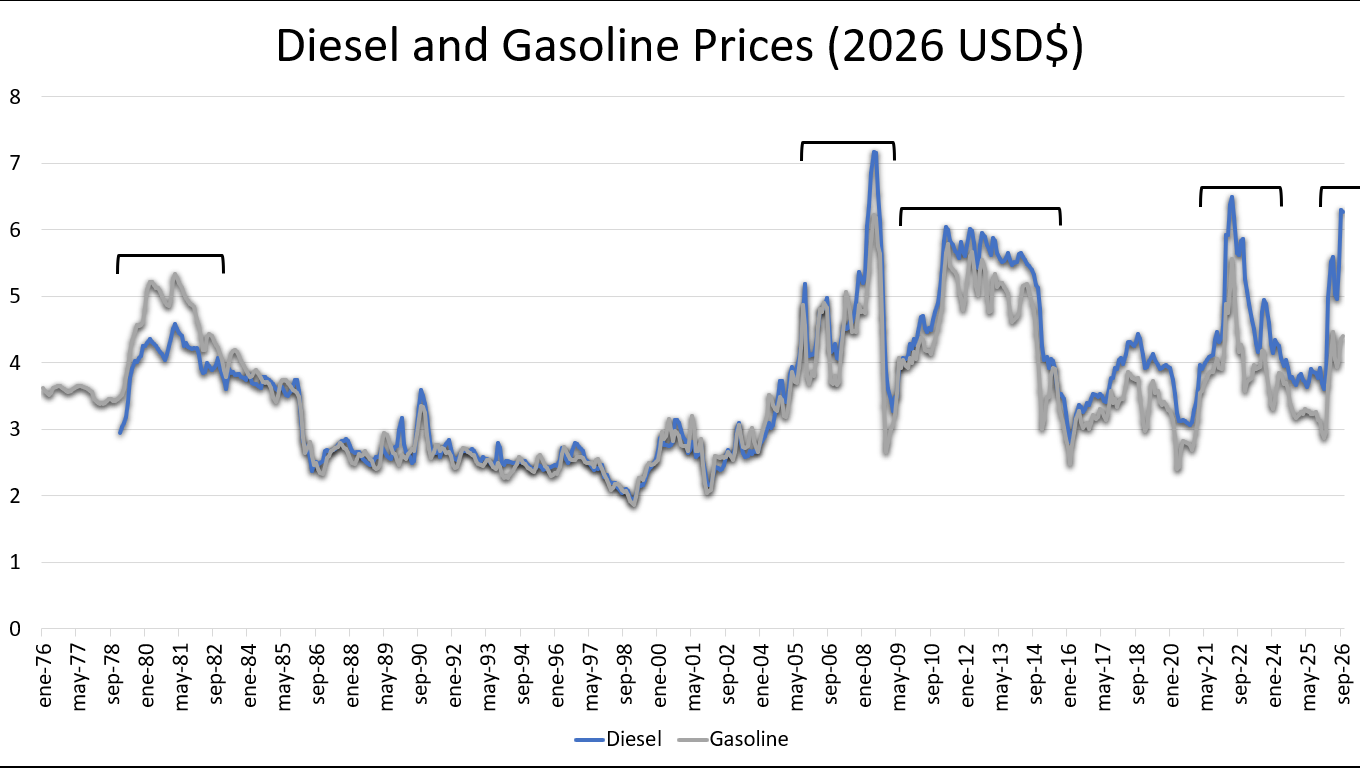
As we will see within the graph, there are 4 such durations prior to now, plus the one we’re residing in right now.
- Late 1979 to late 1983. On this interval, the US entered a recession and world consumption fell from 64mbd to 58.8mbd, an 8.8% decline. That is the one interval in our timeline wherein excessive oil costs have cratered consumption, however, keep in mind, this occurred in a time when the economic system was rather more depending on oil, and it occurred as a result of excessive oil costs triggered a recession.
- Mid 2005 to late 2008. On this interval, oil consumption rose from 83.3mbd to 86.8mbd, a 4.3% enhance. Oil consumption did fall after the 2008 recession, with consumption in 2009 falling to 84.3mbd: this can be a 3.1% decline in comparison with 2008, however since demand was nonetheless up from 2005, it’s honest to say that this decline was due solely to the recession and to not excessive gasoline costs.
- Late 2009 to late 2014. On this interval, world oil consumption grew from 84.3mbd to 92mbd, a 9.1% enhance.
- Late 2021 to late 2023. Oil consumption went from 97mbd to 102.1mbd, a 5.2% enhance.
- March 2026 to the current. And in these few months, oil consumption has fallen by practically 2.5 million barrels in comparison with final yr (-2.4%).
From these numbers, we will simply conclude that in latest occasions, excessive oil costs (on this case outlined by gasoline being over $4 per gallon, adjusted for inflation) haven’t triggered reductions in oil demand. This is the reason many individuals (myself included) thought that costs would wish to go a lot increased than $4–5 {dollars} a gallon to set off demand destruction to the tune of ~2.5mbd we’re seeing right now.
(And, sure, I do know that oil demand has gone down due to bodily limitations out there, however, once more, the purpose right here is that we thought costs would wish to go a lot increased to trigger the demand destruction wanted to stabilize the market on condition that bodily limitation.)
The conclusion, then, is that the identical worth that noticed development yr after yr within the oil market in 2005, 2020, and even 2021 is sufficient to trigger demand to crater in 2026. The one clarification, not less than the one one I discover, is that in 2026, oil demand is rather more influenced by worth.
Remaining ideas
I began saying that this disaster both brought about or displayed the brand new actuality of oil markets. By this, I meant that it’s attainable and even probably that this has been the truth of oil markets for some time, however since we didn’t have a protracted interval of excessive oil (and gasoline) costs, we might probably not put the speculation to the take a look at.
Regardless, this tracks one thing that I stated in my article Echoes of the Previous again when this battle began: the final time we noticed two oil crises as massive and sophisticated as those within the 2020s, the oil market modified ceaselessly: oil consumption per capita, which had grown for many years prior, stabilized; and the oil depth of the economic system began a pattern downwards that turned a everlasting function of the economic system.
This time, I argued, we might even see new modifications, with oil demand per capita falling and the oil depth of the economic system trending in the direction of zero, to the purpose the place general oil demand might begin falling quickly if costs remained up. What I didn’t assume seven months in the past was that this discount in oil demand might occur with costs barely above what we noticed in 2022 or in 2012.
It’s usually quoted that OPEC’s “superb” oil worth is someplace within the $90s or $100s, as as soon as we get to $120 per barrel, we begin to see demand destruction. If my evaluation is appropriate, this quantity is shifting downwards, and shortly we’ll begin to see demand destruction — as quickly as oil reaches $90, then $80, then $70, and so on.
And on this context, it will be good for the oil barons to do not forget that the person that via sheer vanity, stupidity, cruelty, and lack of foresight has vastly accelerated the transition in the direction of a post-oil world is identical they paid hundreds of thousands to get elected to the presidency of the USA. As a result of we’d not be seeing any of this with out the one and solely Donald J. Trump, and his merciless and inhumane battle on Iran.
Join CleanTechnica’s Weekly Substack for Zach and Scott’s in-depth analyses and excessive stage summaries, join our every day publication, and comply with us on Google Information!
Have a tip for CleanTechnica? Need to promote? Need to counsel a visitor for our CleanTech Speak podcast? Contact us right here.
Join our every day publication for 10–15 new cleantech tales a day. Or join our weekly one on high tales of the week if every day is just too frequent.


CleanTechnica makes use of affiliate hyperlinks. See our coverage right here.
CleanTechnica’s Remark Coverage
